Degenerative Disc Disease Treatment in Granada Hills, CA
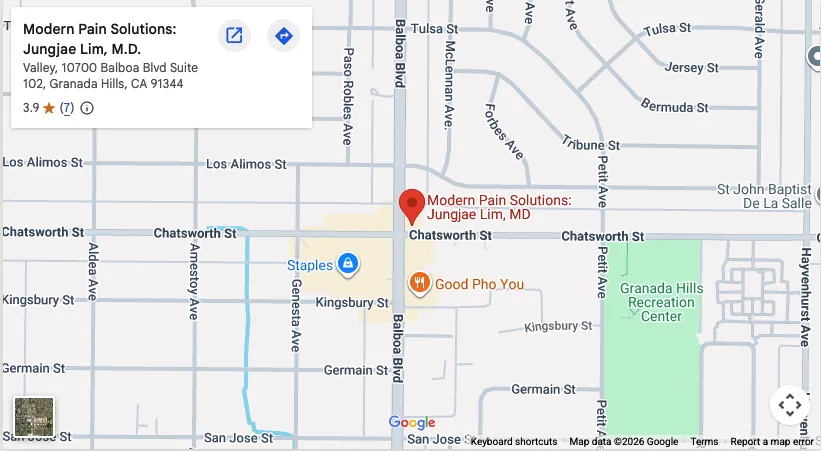
Degenerative disc disease is one of the most common causes of chronic back and neck pain, and while its name sounds alarming, there are highly effective, non-surgical treatments that can significantly reduce your pain and restore your quality of life. At Modern Pain Solutions, Dr. Jungjae Lim provides targeted, minimally invasive treatments designed to address the specific pain generators associated with degenerative disc disease for patients throughout Granada Hills and the San Fernando Valley.
What Is Degenerative Disc Disease?
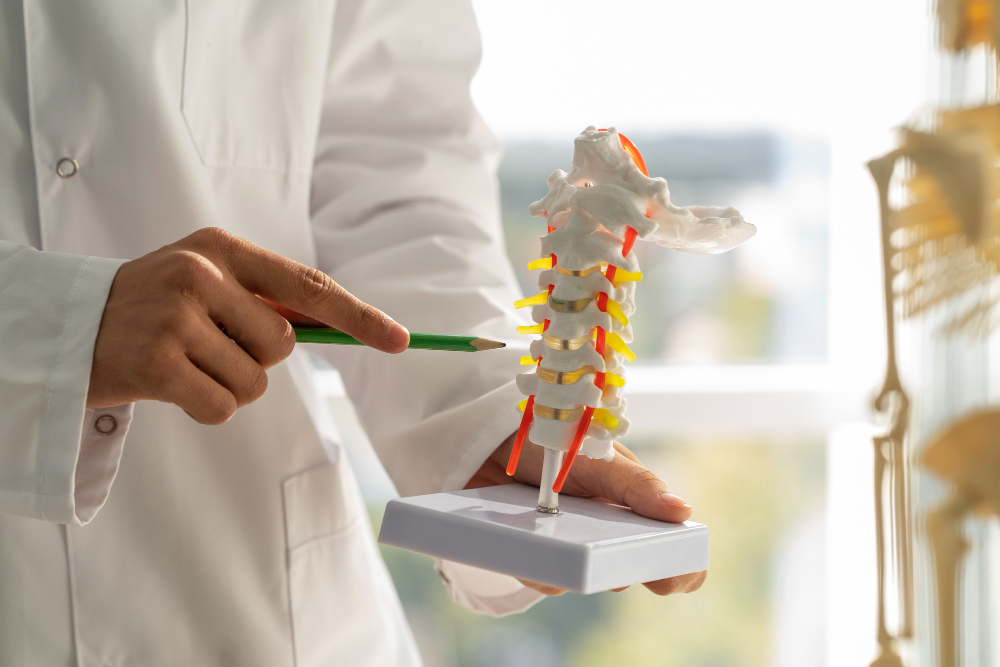
Despite its name, degenerative disc disease (DDD) is not a disease in the traditional sense — it is a term used to describe the natural, age-related changes that occur in the spinal discs over time. The spinal discs naturally lose water content and height as we age, becoming less flexible and less capable of absorbing spinal forces. As discs degenerate, they may bulge, crack, or develop tears in the outer ring (annular tears), leading to pain, inflammation, and — if nerve structures are compressed — radiating symptoms into the arms or legs.
DDD most commonly affects the lumbar spine (particularly the L4–L5 and L5–S1 levels) and the cervical spine. It can contribute to a range of associated conditions including herniated discs, spinal stenosis, facet joint arthritis, and spondylolisthesis. At Modern Pain Solutions in Granada Hills, CA , Dr. Lim takes a precise, image-guided approach to identifying which aspects of disc degeneration are generating your pain and selecting the treatments most likely to provide meaningful, lasting relief.
Symptoms of Degenerative Disc Disease
- Chronic, low-grade back or neck pain that worsens with certain movements
- Flares of acute, severe pain following activity or injury
- Pain that improves with movement and worsens after prolonged sitting or standing
- Radiating arm or leg pain, numbness, or tingling when nerve roots are involved
- Stiffness and reduced range of motion in the spine
- Muscle weakness if nerve compression is significant
Degenerative Disc Disease Treatments at Modern Pain Solutions
Dr. Lim takes a targeted, image-guided approach to managing DDD pain. Treatments include epidural steroid injections, facet joint injections, and medial branch nerve blocks to address acute and chronic disc-related inflammation and facet contributions. Radiofrequency ablation can provide longer-lasting relief from facet-mediated pain. For vertebrogenic (endplate-related) low back pain, the Intracept procedure targets the basivertebral nerve responsible for transmitting pain from degenerating disc endplates. PRP and intradiscal therapies may support disc healing. For advanced neuropathic pain from DDD, spinal cord stimulation is also available. Call (818) 826-4145 to schedule your evaluation today.
Frequently Asked Questions About Degenerative Disc Disease
Is degenerative disc disease serious?
Degenerative disc disease is extremely common — by age 50, the majority of adults show some degree of disc degeneration on imaging — and in many people it causes little to no pain. However, for some individuals, DDD produces significant, chronic pain that interferes substantially with daily life. The term “disease” can be alarming, but it is important to understand that disc degeneration is a natural aging process rather than a dangerous medical condition. At Modern Pain Solutions, Dr. Lim will evaluate the extent of your DDD and how much it is contributing to your symptoms, then recommend treatments accordingly.
What is the difference between DDD and a herniated disc?
Degenerative disc disease refers to the overall age-related breakdown of the disc — loss of height, water content, and structural integrity. A herniated disc is a specific event in which the inner disc material breaks through the outer ring and protrudes into the spinal canal, compressing nerve structures. The two are related — degenerated discs are more susceptible to herniation — but they are distinct conditions that may require different treatment approaches. Dr. Lim will distinguish between them based on your imaging and clinical presentation.
What is the Intracept procedure and how does it help DDD?
The Intracept procedure is an innovative, FDA-cleared treatment for vertebrogenic chronic low back pain — pain originating from the vertebral endplates adjacent to degenerated discs, which can be seen as Modic changes on MRI. During the procedure, Dr. Lim uses fluoroscopic guidance to deliver targeted radiofrequency energy to the basivertebral nerve — the specific nerve transmitting pain signals from the vertebral endplates. By deactivating this nerve, Intracept can provide long-lasting relief for a type of DDD pain that often does not respond adequately to injections or other conservative measures. Learn more on our Minimally Invasive Spine page.
Can DDD cause pain to radiate into the legs or arms?
Yes. When degenerative disc disease leads to disc bulging, herniation, or spinal stenosis that compresses nerve roots, pain, numbness, and tingling can radiate from the lumbar spine into the legs (causing sciatica-like symptoms) or from the cervical spine into the arms. These radiating symptoms indicate nerve involvement and typically warrant prompt evaluation. Dr. Lim will assess whether nerve compression is present and recommend targeted treatments to relieve both the disc-related and nerve-related components of your pain.
Does degenerative disc disease always require surgery?
No. The vast majority of DDD patients can be effectively managed without surgery. At Modern Pain Solutions, Dr. Lim offers a comprehensive range of non-surgical options — from injections and nerve blocks to the Intracept procedure and spinal cord stimulation — that provide meaningful relief for most DDD presentations. Surgery is generally only considered when there is significant structural instability, severe neurological compromise, or failure of all appropriate conservative and interventional options.
Can PRP therapy help with degenerative disc disease?
Emerging evidence suggests that PRP therapy and intradiscal injections of growth factors may help support disc repair and reduce painful annular tears in select patients with DDD. By delivering concentrated healing proteins directly into the disc, PRP aims to stimulate the disc’s limited natural repair capacity and reduce the inflammatory environment contributing to pain. While PRP for discs is still an evolving area of regenerative medicine, Dr. Lim stays current with the evidence and will discuss whether this is an appropriate option for your specific case.
Can physical activity worsen degenerative disc disease?
In general, appropriate physical activity does not worsen degenerative disc disease — and in many cases, staying active is beneficial. Exercise strengthens the muscles that support the spine, maintains flexibility, reduces stiffness, and promotes disc health through improved nutrient exchange. High-impact, axially-loading activities such as heavy lifting, running on hard surfaces, and contact sports may aggravate symptoms during a flare. Dr. Lim can provide guidance on which activities to embrace and which to modify based on your specific DDD presentation and current pain level.