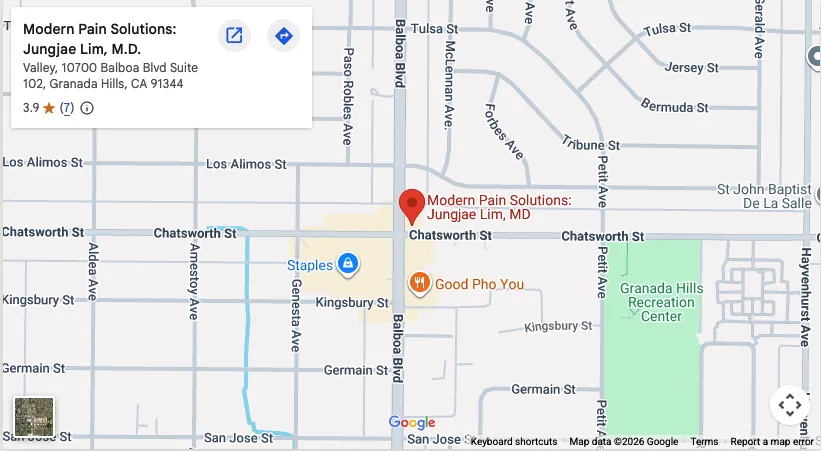
Spinal Stenosis Treatment in Granada Hills, CA
Spinal stenosis is a leading cause of back and leg pain in adults over 50, and it can make walking even short distances agonizing. At Modern Pain Solutions, Dr. Jungjae Lim offers a comprehensive range of non-surgical and minimally invasive treatments specifically designed to relieve the nerve pressure caused by spinal stenosis and restore your ability to move freely and comfortably.
What Is Spinal Stenosis?
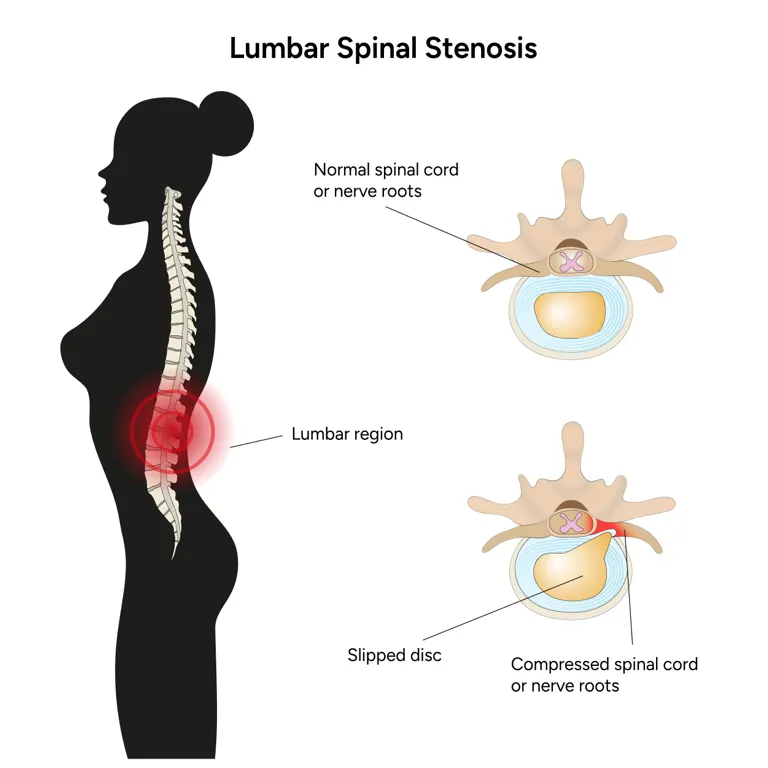
Spinal stenosis is the narrowing of the spinal canal — the bony channel that houses and protects the spinal cord and nerve roots. When this canal becomes too narrow, the nerve structures within it are compressed, producing pain, numbness, and weakness that can significantly impair mobility and quality of life. Stenosis can occur anywhere along the spine but is most common in the lumbar (lower back) and cervical (neck) regions.
Lumbar spinal stenosis classically produces a condition known as neurogenic claudication — leg pain, heaviness, cramping, or weakness that develops after walking or standing for a period of time and is relieved by sitting or bending forward. Many patients describe their symptoms as feeling as if their legs are “giving out” or becoming unbearably heavy after walking even short distances. At Modern Pain Solutions in Granada Hills, CA , Dr. Lim offers targeted treatments that address the underlying compression causing these symptoms.
Common Causes of Spinal Stenosis
- Age-related degenerative changes — bone spurs, thickened ligaments, and arthritic facet joints
- Degenerative disc disease causing disc bulging into the canal
- Spondylolisthesis — forward slippage of one vertebra over another
- Calcification of the posterior longitudinal ligament
- Congenital narrowing of the spinal canal present from birth
Spinal Stenosis Treatments at Modern Pain Solutions
Dr. Lim offers a full spectrum of treatments for spinal stenosis, from epidural steroid injections and medial branch blocks to the MILD procedure and the Vertiflex spacer for patients needing a more durable structural solution. For cases involving significant neuropathic leg pain, spinal cord stimulation may also be appropriate. See our Back & Neck Pain services for related care. Call (818) 826-4145 to schedule your consultation.
Frequently Asked Questions About Spinal Stenosis
What does spinal stenosis feel like?
Spinal stenosis most commonly produces back pain combined with leg pain, heaviness, numbness, or cramping that worsens with standing or walking and is relieved by sitting or bending forward. Some patients describe feeling as if their legs are going to give out after walking short distances. Cervical stenosis may cause arm pain, weakness, and problems with coordination. Dr. Lim can evaluate your symptoms and imaging to confirm a stenosis diagnosis and identify which spinal levels are affected.
Can spinal stenosis be treated without surgery?
Yes, in many cases. At Modern Pain Solutions, Dr. Lim offers a range of non-surgical and minimally invasive options for spinal stenosis. Epidural steroid injections can reduce nerve inflammation and provide meaningful relief. For patients who need a more durable structural solution, the MILD procedure removes excess bone and ligament tissue to decompress the spinal canal without fusion or hardware. Open surgery is typically a last resort.
What is neurogenic claudication?
Neurogenic claudication is the term for leg pain, heaviness, or weakness caused by nerve compression in the lumbar spinal canal — the hallmark symptom of lumbar spinal stenosis. Unlike vascular claudication (caused by poor circulation), neurogenic claudication is relieved by sitting down or bending forward, which temporarily opens the spinal canal. If you experience these symptoms, a consultation at Modern Pain Solutions can determine whether stenosis is responsible and what treatments are most appropriate.
What is the MILD procedure and how does it help stenosis?
The MILD procedure (Minimally Invasive Lumbar Decompression) is an outpatient treatment in which Dr. Lim uses specialized micro-instruments and fluoroscopic guidance to remove small pieces of excess bone and thickened ligament tissue that are narrowing the spinal canal. This directly addresses the structural cause of lumbar stenosis without requiring incisions, general anesthesia, or implanted hardware. Many patients experience significant improvement in their ability to stand and walk following the procedure. Learn more on our Minimally Invasive Spine page.
How does the Vertiflex procedure differ from the MILD procedure for stenosis?
Both the MILD procedure and Vertiflex treat lumbar spinal stenosis, but through different mechanisms. The MILD procedure removes excess tissue to physically open the canal. The Vertiflex procedure implants a small titanium spacer between two adjacent vertebrae to mechanically hold the canal open during upright postures — the positions that trigger stenosis symptoms most severely. The best choice depends on your anatomy, degree of stenosis, and other clinical factors that Dr. Lim will assess during your evaluation.
Does spinal stenosis get worse over time?
Spinal stenosis tends to progress gradually as degenerative changes in the spine continue with age. Without treatment, many patients experience worsening symptoms over months to years. However, the pace of progression varies considerably between individuals, and not everyone experiences rapid deterioration. Addressing stenosis early with appropriate interventional or minimally invasive treatments can significantly slow the impact on your function and quality of life. Call (818) 826-4145 to discuss your situation with Dr. Lim.
Can spinal stenosis cause permanent nerve damage?
In severe or long-standing cases of untreated spinal stenosis, persistent nerve compression can lead to permanent weakness, numbness, or — in the most extreme cases — loss of bladder and bowel function. This is why early evaluation and treatment are important. If you are experiencing worsening weakness or any loss of bladder or bowel control alongside your spinal stenosis symptoms, seek urgent medical attention. For other stenosis concerns, call Modern Pain Solutions at (818) 826-4145 to schedule your evaluation.