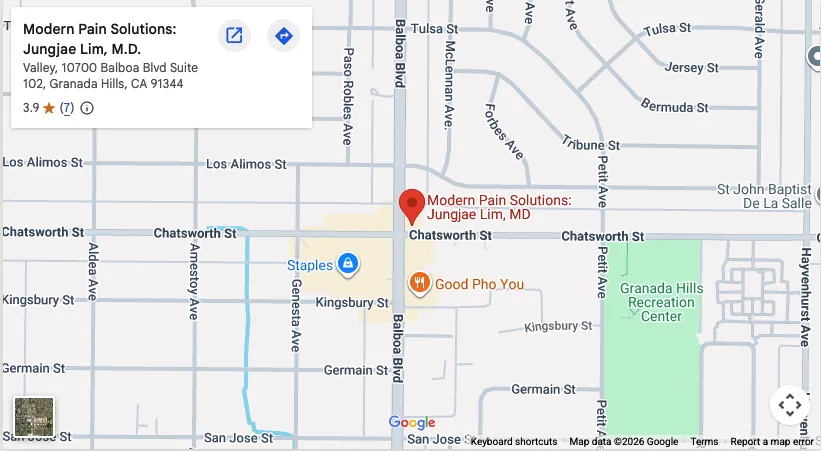
Herniated Disc After a Car Accident in Granada Hills, CA
A traumatic disc herniation is one of the most serious and common spinal injuries caused by car accidents — and it requires expert evaluation and targeted interventional treatment to prevent acute injury from becoming a permanent condition. At Modern Pain Solutions, Dr. Jungjae Lim specializes in diagnosing and treating accident-related disc herniations for patients throughout Granada Hills, the San Fernando Valley, and Los Angeles. We accept lien-based cases and work directly with your attorney. Call (818) 826-4145.
How Car Accidents Cause Disc Herniations
The spinal discs act as shock absorbers between the vertebrae. During a car accident, the sudden forces of impact — compression, extension, flexion, rotation, or a combination — can exceed the structural tolerance of the disc’s outer ring (the annulus fibrosus). When this happens, the soft inner material (the nucleus pulposus) can push through the weakened outer ring and into the spinal canal, where it may compress nearby nerve roots or, in severe cases, the spinal cord itself.
Traumatic disc herniations can occur in the cervical spine (neck), the lumbar spine (lower back), and less commonly the thoracic spine (mid-back). They can occur in isolation following a single severe impact or develop progressively after an accident accelerates degeneration in a previously vulnerable disc. At Modern Pain Solutions in Granada Hills, CA , Dr. Lim evaluates both acute traumatic herniations and accident-accelerated disc injuries — documenting the relationship between the accident and the disc pathology for your legal case.
Symptoms of a Disc Herniation After a Car Accident
- Cervical disc herniation (neck): Neck pain, stiffness, and pain that radiates from the neck into the shoulder, arm, or hand following the distribution of the compressed nerve. Numbness, tingling, and weakness in the arm or hand are common.
- Lumbar disc herniation (lower back): Lower back pain combined with sciatica — radiating pain, numbness, or weakness that travels from the lower back through the buttock and into the leg and foot.
- Pain that worsens with coughing, sneezing, bending, or straining — increased intradiscal pressure aggravates herniation symptoms.
- Muscle weakness — significant nerve compression can cause measurable weakness in the arm or leg muscles supplied by the affected nerve.
- Loss of reflexes — reduced deep tendon reflexes corresponding to the affected nerve level.
Proving a Disc Herniation Was Caused by Your Accident
In personal injury cases, insurance companies frequently argue that disc herniations are pre-existing degenerative conditions unrelated to the accident. Dr. Lim is experienced in documenting the causal relationship between a traumatic accident and a disc herniation — addressing issues such as pre-accident imaging comparisons, the mechanism of injury, the temporal relationship between the accident and the onset of symptoms, and the clinical evidence of acute versus chronic disc pathology.
A thorough, physician-authored causation opinion from Dr. Lim can be a critical asset to your attorney in rebutting defense arguments and establishing the true origin of your disc injury. This documentation is a standard part of the evaluation and treatment process at Modern Pain Solutions for all personal injury patients.
Disc Herniation Treatments at Modern Pain Solutions
Dr. Lim offers evidence-based, non-surgical treatments for accident-related disc herniations, all performed under imaging guidance and documented for legal purposes:
- Epidural steroid injections — Delivering anti-inflammatory medication directly to the inflamed nerve root for targeted, rapid relief of radiating arm or leg pain. Part of our full injection therapy program.
- Selective nerve root blocks — Targeted injections at the specific nerve level affected by the herniation, providing diagnostic and therapeutic benefit.
- PRP and intradiscal therapy — Regenerative injections designed to support disc tissue healing and reduce painful annular tears. See our PRP Therapy page.
- Spinal cord stimulation — For patients with chronic, refractory neuropathic pain following a traumatic disc herniation. See our Neuromodulation page.
- Physical therapy coordination — Core stabilization and decompression-focused exercises to support disc healing and prevent recurrence.
Modern Pain Solutions accepts lien-based cases for accident disc herniation patients. Call (818) 826-4145 to schedule your evaluation. For more information on how we support personal injury patients and their attorneys, visit our Personal Injury page.
Frequently Asked Questions — Herniated Disc After an Accident
Can a car accident cause a disc herniation?
Yes. Car accident forces — particularly those generated in rear-end, head-on, and side-impact collisions — are sufficient to cause disc herniations in both the cervical and lumbar spine. Even relatively low-speed collisions can herniate a disc, particularly if the disc had any pre-existing vulnerability from normal aging. The sudden, uncontrolled acceleration-deceleration forces of a crash can overwhelm the structural tolerance of the disc’s outer ring in milliseconds.
How do I know if I have a herniated disc from my accident?
The hallmark symptom of a disc herniation is radiating pain — pain that travels from the spine into an arm (cervical herniation) or leg (lumbar herniation) along the path of the compressed nerve. This is typically accompanied by numbness, tingling, and in more severe cases, muscle weakness. However, some disc herniations cause primarily local back or neck pain without radiating symptoms. An MRI is the gold standard for diagnosing disc herniations and is typically the first imaging study Dr. Lim will review or order at your evaluation.
Will the insurance company try to say my disc herniation is pre-existing?
This is one of the most common defense arguments in disc herniation personal injury cases. Insurance companies frequently argue that degenerated-looking discs on MRI are pre-existing and unrelated to the accident. Dr. Lim is experienced in writing causation opinions that address this argument directly — analyzing the mechanism of injury, the temporal relationship between the accident and onset of symptoms, the type of disc pathology seen on imaging, and the clinical evidence of acute versus chronic injury. A well-documented causation opinion from a double board-certified specialist like Dr. Lim carries significant weight in these disputes.
Do I need surgery for a disc herniation from a car accident?
In the majority of cases, no. Dr. Lim takes a non-surgical first approach to accident-related disc herniations. Epidural steroid injections, selective nerve root blocks, regenerative therapies, and physical therapy can provide significant, meaningful relief for most patients without surgery. Surgery is typically considered only when neurological deficits are severe and progressive, or when all appropriate interventional treatments have been exhausted without adequate relief.
Does Modern Pain Solutions treat traumatic disc herniations on a lien?
Yes. Modern Pain Solutions accepts lien-based cases for patients with disc herniations caused by car accidents and personal injuries. You can receive expert evaluation and treatment from a double board-certified pain specialist with no upfront cost — payment is deferred until your case resolves. Call (818) 826-4145 to determine your eligibility for lien-based care.
How quickly should I see a doctor after a disc herniation from a car accident?
As soon as possible — ideally within the first week after the accident. Prompt evaluation serves two critical purposes: it begins your treatment early, when intervention is most effective, and it creates an unbroken documentation trail that directly connects your disc herniation to the accident. Delays in seeking care can be used by defense attorneys and insurance adjusters to argue that your injuries were not caused by the accident or were not serious enough to require immediate attention. Call (818) 826-4145 to schedule a rapid evaluation at Modern Pain Solutions.
Can a disc herniation from an accident get worse over time?
Yes. An untreated or inadequately treated disc herniation can worsen over time — with progressive nerve compression causing increasing pain, numbness, and weakness. Chronic nerve irritation can lead to permanent neurological deficits if not addressed. Additionally, a traumatic herniation can accelerate degenerative changes at the affected disc level, leading to spinal stenosis and other long-term complications. Early, targeted intervention at Modern Pain Solutions is the most effective way to prevent a traumatic disc herniation from becoming a permanent impairment.